
Measuring guide
How to measure for a file drawer: step by step
For anyone putting a hanging file drawer into a desk pedestal, a kitchen base, a credenza or a built in, or replacing a desk file drawer that gave out. About 15 minutes with a tape measure, ending with the numbers our configurator asks for: box width, box depth or runner length, the file layout your opening allows, and your slide model.
Quick answer. Measure three things with the drawer out: the clear opening width at the front, inside face to inside face (A), the clear height from the cabinet floor to the underside of the rail or drawer above (B), and the inside depth from the front edge to the back panel (C). The box is A minus 1 in on side mount slides or minus 13/32 in (10 mm, often written 3/8 in) on most undermount runners with 5/8 in sides, and it must reach 14 1/4 in wide for letter folders or 17 1/4 in for legal; a narrower opening takes a lateral layout, sized by depth instead (14 5/16 in letter, 17 5/16 in legal). Every file box is 10 1/4 in tall (10 3/8 in with a 1/2 in bottom), so B should be at least 11 1/16 in on most undermount runners, and we suggest about 11 1/2 in so the folder tabs clear. Enter the box width as “Width (Inches)” plus “Width Fraction”, the depth as “Custom Depth (Inches)” for side mount or the runner length under “Depth Selection” for undermount, and the layout under “File layout”.
Ready to build it? The configurator prices every choice live and draws your box in 3D before you order.
What you need
- A steel tape measure you can read to the nearest 1/32 in. We cut to the 1/32 inch.
- A pencil and the worksheet at the end of this page: print it or screenshot it.
- Your phone camera, for the opening, the old box and the slide label.
- A flashlight for the back of the cabinet and the model printed on the runner.
- A helper for a wide credenza opening, so the tape stays straight.
Before you start
- Empty the cabinet and pull the drawer that lives in the opening. Pull the one above only if its box or slides hang down into the opening.
- Doors. A file drawer sits behind its own front, so there is usually no door to remove. Converting a door cabinet? Lift the doors off their hinges to reach the opening squarely, and note any hinge plate inside it: a side mount slide will want a spacer there.
- Find the clear opening: the smallest rectangle the box must pass through, at the front of the cabinet where the slides mount.
- Face frame or frameless. On a face frame cabinet every number is taken between the stiles, because the slides mount flush with them on blocking or rear brackets. A frameless opening is the inside of the box itself.
- Decide the slides now, because the slide sets the box width. Drawer slide types compares side mount and undermount, and find my drawer identifies an existing slide from a photo.
Step 1: measure the opening width (A)

Hook the tape on one inside wall of the file opening and read it at the other, inside face to inside face, at the front of the cabinet where the slides mount: side panel to side panel on a frameless cabinet, stile to stile on a face frame. Take it near the top, the middle and the bottom and keep the smallest. Write it as A. The pedestal in the photo reads 13 1/2 in, what a 15 in frameless pedestal with 3/4 in sides gives you.
A sets the box width and the layout. The box is A minus 1 in on side mount slides, or A minus 13/32 in (10 mm, often written 3/8 in) on most undermount runners with 5/8 in sides (our undermount slide guide lists each runner’s own figure). With 5/8 in sides the box must reach 14 1/4 in for letter folders front to back and 17 1/4 in for legal, because letter rails sit 12 1/4 in apart and legal rails 15 1/4 in, outside to outside, inside the box walls.
| Front to back layout | Smallest box, 5/8 in sides | Smallest A, undermount (box plus 13/32 in) | Smallest A, side mount (box plus 1 in) |
|---|---|---|---|
| LETTER | 14 1/4 in | 14 5/8 in | 15 1/4 in |
| LEGAL, OR SLOTS FOR BOTH | 17 1/4 in | 17 5/8 in | 18 1/4 in |
| DOUBLE LETTER | 27 1/4 in | 27 5/8 in | 28 1/4 in |
| LETTER AND LEGAL SIDE BY SIDE | 30 1/4 in | 30 5/8 in | 31 1/4 in |
| DOUBLE LEGAL | 33 1/4 in | 33 5/8 in | 34 1/4 in |
| LATERAL LETTER OR LEGAL | Any width: sized by depth instead, see Step 4 | ||
Common mistake: measuring across the outside of the face frame or across the old drawer front. Both are wider than the opening.
Tip: 1/2 in sides lower each minimum by 1/4 in and 3/4 in sides raise it by 1/4 in. An opening under 14 5/8 in goes to Step 4 and a lateral layout; the full chart is in letter vs legal file drawer dimensions.
Step 2: measure the opening height (B)

Stand the hook of the tape on the cabinet floor, or on the bottom rail of a face frame opening, and read it plumb at the underside of whatever the folder tabs must pass under when the drawer closes: the rail above the opening, the drawer box above, or the desk top. Write it as B.
Every file drawer we build is 10 1/4 in tall with our standard 1/4 in bottom, or 10 3/8 in with a 1/2 in bottom, so hanging folders get their 9 3/8 in of clear drop. Most undermount runners (Blum, Hettich, Würth, KV and Accuride) want the box side 13/16 in under the opening, so a 10 1/4 in box needs B of at least 11 1/16 in and a 10 3/8 in box 11 3/16 in; Salice Futura wants 1 in, so 11 1/4 in and 11 3/8 in. Side mount slides set no height rule of their own. Folder tabs stand about 1 in above the rail, so we suggest B of about 11 1/2 in or more, our working suggestion from the shop rather than a slide maker’s figure.
Common mistake: measuring the old drawer front. Fronts overlap the opening, so a 12 in front can hide an opening of 11 in or less.
Tip: if B lands between 11 1/16 in and 11 1/2 in, keep the 1/4 in bottom so the box stays at 10 1/4 in, and use plain folder tabs. The height rules by runner are in how tall a file drawer needs to be.
Step 3: measure the inside depth (C) and pick the slide length

Lay the tape on the cabinet floor from the front edge of the cabinet, the face of the frame or the front edge of the side panel, straight back to the inside of the back panel. Write it as C. Shine the flashlight in: an outlet, a pipe or a back panel set in from the rear edge shortens what you can use, so measure to it instead.
C sets the box depth through the slide. On undermount runners the box depth equals the runner length, so pick the longest length on your runner’s list that fits inside C with room behind it for the rear bracket or the back panel: a 21 in runner in a 24 in deep base or pedestal (about 23 in inside), an 18 in runner in a 22 in deep pedestal. Lengths run 9 to 30 in by model, and each brand page in the undermount slide guide gives the runner’s minimum cabinet depth. On side mount slides the box depth is about C minus 1 in, any 1/32 in step from 9 to 24 31/32 in, so 22 in in a 24 in deep cabinet.
Common mistake: starting the tape at the drawer front or the counter overhang, which adds 3/4 in or more that is not inside the cabinet.
Tip: a file drawer wants full extension, because the back folders have to come all the way out to you. We stock full extension undermount runners and side mount slides; which suits a drawer full of paper is in file drawer slides.
Step 4: check lateral layouts by depth
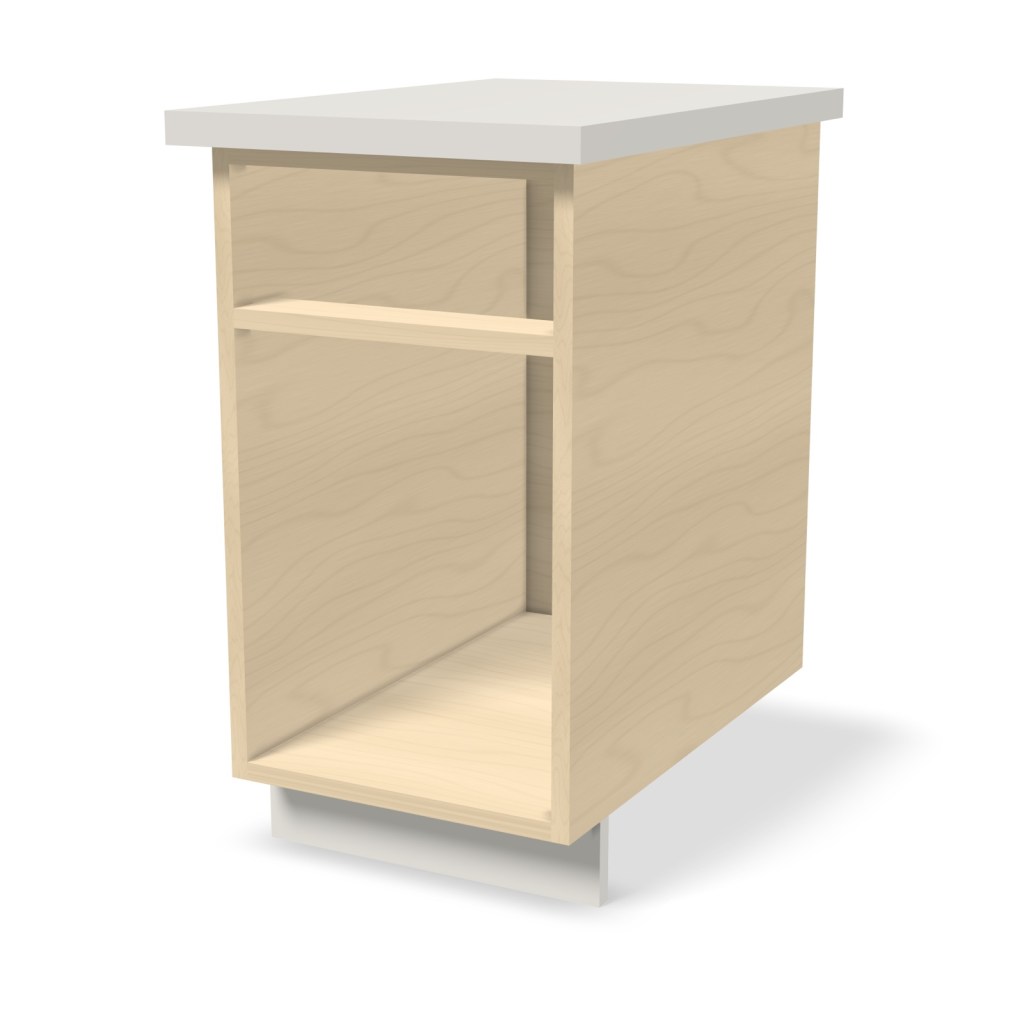
If A cannot reach the width a front to back layout needs, turn the folders sideways. A lateral layout hangs the rails side to side in slots in the box sides, so it is sized by depth: with 5/8 in sides, lateral letter needs a box at least 14 5/16 in deep, lateral legal 17 5/16 in, double lateral letter 27 5/16 in. Compare those to the box depth from Step 3, pick the layout, and write it as E.
The pedestal in the photo is the usual case: its 13 1/2 in opening gives a 13 1/8 in box on undermount runners, under the 14 1/4 in letter needs front to back, while a 21 in runner makes the box 21 in deep, well past 14 5/16 in. Lateral letter it is.
| Lateral layout | Smallest box depth, 5/8 in sides | Shortest runner that clears it | Side mount box depth that clears it |
|---|---|---|---|
| LATERAL LETTER | 14 5/16 in | 15 in | 14 5/16 in or deeper |
| LATERAL LEGAL | 17 5/16 in | 18 in | 17 5/16 in or deeper |
| DOUBLE LATERAL LETTER | 27 5/16 in | 30 in | Not possible without notching (24 31/32 in limit) |
Common mistake: expecting a lateral drawer to need less height. The folders hang just as deep, so B applies unchanged.
Tip: when A does reach the minimum you can still choose lateral for one long run of folders; lateral vs front to back file drawers weighs the two.
Step 5: tell a desk pedestal from a kitchen base cabinet

The same three numbers apply everywhere, but the cabinet decides which layouts are realistic, so write down what you have as F: desk pedestal, kitchen base, credenza or built in, and face frame or frameless. Office furniture pedestals are about 15 in wide for letter and 18 in for legal, 22 to 24 in deep, with thin metal sides; a wood pedestal of the same width has 3/4 in panels and loses 1 1/2 in of opening to them, which is why a 15 in wood pedestal goes lateral. A kitchen base cabinet is 24 in deep and 34 1/2 in tall: a frameless 18 in base has a 16 1/2 in opening and takes letter front to back (a 16 1/8 in box on undermount runners), a 21 in base has 19 1/2 in and takes letter or legal, and a 15 in base takes lateral letter only. The cabinet in the photo is an 18 in base with a letter drawer on a 21 in runner.
A face frame cabinet with 1 1/2 in stiles loses 3 in instead of 1 1/2 in: an 18 in face frame cabinet gives a 15 in opening, enough for letter on undermount runners (a 14 5/8 in box) but not on side mount slides (14 in). Measure between the stiles, because stile widths vary. Heights work the same in both rooms: a 5 in pencil drawer opening over an 11 1/2 in file opening fits a 34 1/2 in kitchen base or a 28 1/2 in desk height base. Cabinet by cabinet tables are in a file drawer in a kitchen cabinet and built in desk file drawer dimensions.
Common mistake: planning a letter file drawer in a 15 in wood pedestal because a furniture catalog says letter pedestals are 15 in wide. That figure is for a metal pedestal with thin sides.
Step 6: measure an old file drawer you are replacing

When the old file drawer is still around, measure the box itself: a box that ran well on its slides is the best template there is. Set it on a bench and ignore the drawer front. Outside width across the side faces, at the front and the back, keep the smaller (write it as G); outside depth from the front face of the box to the back face (H); height of a side panel (I). Then across the old rails, outside to outside: 12 1/4 in is letter, 15 1/4 in is legal. Note front to back or side to side, and whether they were bars in slots, hangers built into the box, or a clip on frame (J).
Last, the slide, D on the worksheet: a rail screwed to each side of the box is side mount; hooks at the back and nothing on the sides is undermount, with the brand and model printed on the runner left in the cabinet. Photograph the label. The new box gets G for its width and H for its depth, and the old front screws straight onto it. Old desk file boxes are often 9 1/2 to 10 in tall where ours is 10 1/4 in, or 10 3/8 in with a 1/2 in bottom, so check I against B. To keep a clip on frame, order slots only.
Common mistake: measuring the drawer front instead of the box. Fronts overlap the cabinet, so they are wider and taller than the box.
Tip: no label on the runner? Send a photo through find my drawer, or pick the Other or unlisted slide model choice in the configurator and type what you can read. The whole replacement job is in built in desk file drawer dimensions and replacement drawer boxes.
Every measurement on one drawing
Three numbers on the cabinet, A, B and C, and the box they produce. The letters match the worksheet below.
Your worksheet
Print it or screenshot it and fill it in on your phone. Rows G to J are for a replacement where the old box is still around. To have us check the numbers, send a photo of the filled table with the instant quote.
| Letter | What it is | Your number | Rule or minimum |
|---|---|---|---|
| A | Clear opening width at the front, smallest of three | ______ in | A minus 1 in (side mount) or minus 13/32 in (10 mm, often written 3/8 in) (most undermount) = box; letter needs 14 1/4 in, legal 17 1/4 in |
| B | Clear opening height, floor to the rail or drawer above | ______ in | At least 11 1/16 in on most undermount runners, 11 1/4 in on Salice Futura; about 11 1/2 in suggested |
| C | Inside depth, front edge to back panel | ______ in | Undermount: longest runner that fits with room behind; side mount: about C minus 1 in |
| D | Slide type, brand, model and length | __________ | From the runner label; side mount keeps “Notching” on “None” |
| E | File layout the numbers allow | __________ | Front to back by width; lateral by depth, 14 5/16 in letter, 17 5/16 in legal |
| F | Cabinet type, face frame or frameless | __________ | Face frame: measure between the stiles |
| G | Old box outside width, smaller of front and back | ______ in | New box width = G |
| H | Old box outside depth, without the front | ______ in | New box depth = H |
| I | Old box side height | ______ in | Ours is 10 1/4 or 10 3/8 in; check B |
| J | Old rail spread, outside to outside, and direction | ______ in | 12 1/4 in letter, 15 1/4 in legal; clip on frame means slots only |
Have your numbers? Build your file drawer: the live 3D preview draws the box at your size with the rails and folders in it, the price updates with every choice, and a red warning holds Add to cart if the box is too narrow or too shallow for the layout. Not sure about a number? Send us a photo and your measurements and we check them before you order.
Turn your numbers into an order
Open the custom file drawer box configurator with the worksheet beside you. Every size you enter is the outside of the box, and we build exactly that, cut to the 1/32 inch. There is no height field: the bottom sets it.
| Worksheet | Configurator field | What to enter |
|---|---|---|
| A, D | “Width (Inches)” and “Width Fraction” | The box width, whole inch first and the 1/32 in step second: 16 1/8 in is “16” Dovetail Drawer Box” plus “1/8″” |
| D | “Notching” and “Slide Brand/Model” | “None” for side mount; “Notched & Drilled For Undermount Slides” for undermount, then your runner |
| C | “Custom Depth (Inches)” and “Depth Fraction”, or “Depth Selection” | About C minus 1 in for side mount; the runner length for undermount, which replaces the two depth fields |
| E | “File layout” and “Rail alignment” | The layout your width or depth reaches; front to back layouts add “Center (our standard)”, “Left” or “Right” |
| B | “Drawer Bottom Thickness/Wood Type” | A 1/4 in bottom builds the box 10 1/4 in tall, a 1/2 in bottom 10 3/8 in; check against B |
| J, D | “File rails” and “Clips” | “Include aluminum rails, cut to fit” or “Slots only, no rails”; your runner’s clips once the model is picked |
Worked example: an 18 in kitchen base on Blum runners
Say A is 16 1/2 in, B 11 3/4 in and C 23 1/4 in on a frameless 18 in base, on Blum TANDEM plus BLUMOTION 563 runners. The box is 16 1/2 minus 3/8, so 16 1/8 in wide; a 21 in runner fits inside 23 1/4 in with room behind it, so 21 in deep; 16 1/8 in clears the 14 1/4 in letter minimum but not the 17 1/4 in legal minimum, so letter front to back; and B of 11 3/4 in clears the 11 3/16 in a 10 3/8 in box needs, so a 1/2 in bottom for a drawer full of paper is fine. Everything not listed stays on its default:
| Field | Choice |
|---|---|
| Width (Inches) | 16″ Dovetail Drawer Box |
| Width Fraction | 1/8″ |
| Notching | Notched & Drilled For Undermount Slides |
| Slide Brand/Model | Blum TANDEM plus BLUMOTION 563 |
| Depth Selection | 21” Inches (D) |
| File layout | Letter, front to back |
| Rail alignment | Center (our standard) |
| File rails | Include aluminum rails, cut to fit |
| Clips | Blum T51.1901 Clips |
| Drawer Bottom Thickness/Wood Type | 1/2″ Thick Baltic Birch Bottom, which makes the box 10 3/8 in tall |
The pedestal from the photos, 13 1/2 in opening on the same runners, becomes a 13 1/8 in wide, 21 in deep box: “13” Dovetail Drawer Box”, “1/8″”, and “Lateral letter, rails side to side” under “File layout”; no “Rail alignment” field appears for lateral layouts. Check the spec summary under the preview against the worksheet before you add to cart. Every field is explained in the file drawer configurator guide.
Check your numbers
- One deduction, not two. 1 in off A for side mount slides or 13/32 in (10 mm, often written 3/8 in) for most undermount runners, once; an old box measured as G and H takes nothing off.
- Width limits. 6 to 35 31/32 in; a triple layout needs more and goes through the instant quote.
- Width minimums, 5/8 in sides. Letter 14 1/4 in; legal or slots for both 17 1/4 in; double letter 27 1/4 in; letter and legal side by side 30 1/4 in; double legal 33 1/4 in. 1/2 in sides lower each by 1/4 in, 3/4 in sides raise each by 1/4 in.
- Depth minimums for lateral. 14 5/16 in letter, 17 5/16 in legal, 27 5/16 in double lateral letter. A notched box is a whole inch runner length; an unnotched box runs 9 to 24 31/32 in.
- The 9 3/8 in drop is built in. Your job is B: 11 1/16 in on most undermount runners (11 3/16 in with a 1/2 in bottom), 11 1/4 in on Salice Futura, about 11 1/2 in for tabs.
- Smallest of three. A is the narrowest point at the front; a box a hair small still runs, a hair big binds.
- What the live 3D preview flags. A red warning and a held Add to cart when the box is too narrow or too shallow for the layout. It cannot see your cabinet, so B and C are yours to check against the Dimensions callouts and the spec summary; on a phone the bottom bar shows the live price and a Preview button.
- Before you order. A box built to your measurements is not returnable and there is no fit guarantee. The wood box carries a lifetime warranty, hardware 1 year, and we remake anything we built wrong once you send photos.
File drawer measuring questions
My opening is 14 inches wide. Can I still get a letter file drawer?
Not front to back. A 14 in opening gives a 13 5/8 in box on undermount runners or 13 in on side mount slides, and letter rails front to back need a box at least 14 1/4 in wide with 5/8 in sides, or 14 in with 1/2 in sides. Order lateral letter instead: the box only needs to be 14 5/16 in deep, which any 15 in or longer runner gives you.
How do I measure a face frame cabinet for a file drawer?
Measure between the stiles for A and from the bottom rail to the underside of the top rail for B, because the frame opening is what the box passes through, then take the slide deduction. The slides mount flush with the stiles on blocking or rear brackets, so the wider box behind the frame does not help. An 18 in face frame cabinet with 1 1/2 in stiles has a 15 in opening: letter works on undermount runners (a 14 5/8 in box) but not on side mount slides (14 in).
Do I have to take out the drawer above to measure the height?
Only if you cannot get the tape under it. B runs from the cabinet floor to the lowest thing the folder tabs must pass under: the face frame rail, the stretcher, or the drawer box above with its slides. If that box hides the number, pull it, measure to the underside of its slide members, and put it back.
How much cabinet depth does an undermount runner need?
The runner length plus room behind it for the rear mounting bracket or the back panel; each runner’s brand page in our undermount slide guide gives the exact minimum. In practice a 21 in runner is the usual pick for a 24 in deep base or pedestal, and an 18 in runner for a 22 in deep pedestal.
Where do I find the brand and model of my slides?
On the runner itself. Pull the drawer and read the member that stays in the cabinet, where undermount runners carry the maker and model and side mount slides are usually stamped. If nothing is legible, send a photo through find my drawer, or choose the Other or unlisted slide model entry in the configurator and type what you can read.
How accurate do my measurements need to be?
We cut the box to the 1/32 inch, so read the tape as closely as it allows and write the fraction down. When the opening reads between two marks, use the smaller one: a box a hair under still runs, a box a hair over binds. Measure A in three places and keep the smallest.
Can I send photos instead of measuring?
Photos help us check your numbers but cannot replace them: a box built to your measurements is not returnable, so the measurements have to be yours. Fill the worksheet, then send a photo of it with the opening and the slide label through the instant quote, and we check the deduction, the layout and the height before you order.
Do I measure the depth with or without the drawer front?
Without. The drawer front overlays the cabinet and is never part of the box, so C runs from the front edge of the cabinet to the back panel, and an old box is measured from its own front face to its back face. On undermount runners the box depth equals the runner length; on side mount slides it is about C minus 1 in.
Related reading
- File drawer configurator guide: every field in order, with worked builds.
- How tall a file drawer needs to be: the 9 3/8 in rule and the opening each runner needs.
- Letter vs legal file drawer dimensions: box widths and openings for every layout.
- Lateral vs front to back file drawers: when to turn the folders sideways.
- A file drawer in a kitchen cabinet: which base cabinet takes which layout.
- Built in desk file drawer dimensions: pedestal sizes and replacing a desk drawer.
- File drawer installation: rails, slides, front and adjustment once the box arrives.
- Undermount drawer slide guide: each runner’s deduction, depths and minimum cabinet depth.
Three numbers, one file drawer that fits
Take A, B and C to the configurator and watch it draw your box with the rails and folders in it. Every option shows its price as you build, and we build to order in our Las Vegas shop, cut to the 1/32 inch, with a lifetime warranty on the wood box and free retail shipping. For a triple layout or an opening the configurator cannot take, describe it on the instant quote.