
Measuring guide
How to measure for a divided drawer: step by step
For the homeowner or cabinet shop ordering a drawer box with the dividers built in. About twenty minutes, half at the cabinet and half at the counter, and you end up with the outside box size, the two divider counts and the size of every compartment, which is all the configurator asks for.
Quick answer. Measure the clear opening width (A), height (B) and inside depth (C). The box is A minus 13/32 in (10 mm, often written 3/8 in) for Blum style undermount slides with 5/8 in sides, A minus 1 in for side mount slides, and at most B minus 3/4 in tall. Subtract 1 1/4 in from the box width for the inside width, take off 1/4 in per divider, divide by the bays, and check each bay against your widest piece plus 1/2 in. Those numbers fill “Width (Inches)”, “Height (Inches)”, the depth field and the two divider counts on the custom product, or “Cabinet opening”, “Box height” and “Divider layout” on the standard product.
Ready to build it? The configurator prices every choice live and draws your box in 3D before you order.
What you need
- A tape measure with 1/32 in marks; we cut to the 1/32 inch.
- A pencil and the worksheet at the end of this page.
- Your phone camera and a flashlight for the slide label.
- A helper for cabinets over 30 in wide.
- The things that go in the drawer, in groups on the counter.
Before you start
Empty the drawer and take it out: on undermount runners pull it fully open, squeeze the release levers under the front corners and lift; on side mount slides press the lever on each slide. Doors stay on their hinges unless one swings across the opening. Note where the slide gripped the box, on the side (side mount) or underneath at the back with a notch (undermount), and read the model off the label, such as Blum TANDEM 563H; the find my drawer page helps when the label is gone. The clear opening is inside the frame, stile to stile and rail to rail, on a face frame cabinet, and between the cabinet sides, floor or drawer below to stretcher above, on a frameless one. If the old box ran well on slides you are keeping, measure its outside width, depth and height instead; the plain drawer box measuring guide shows both cases.
Step 1: measure the clear opening width (A)
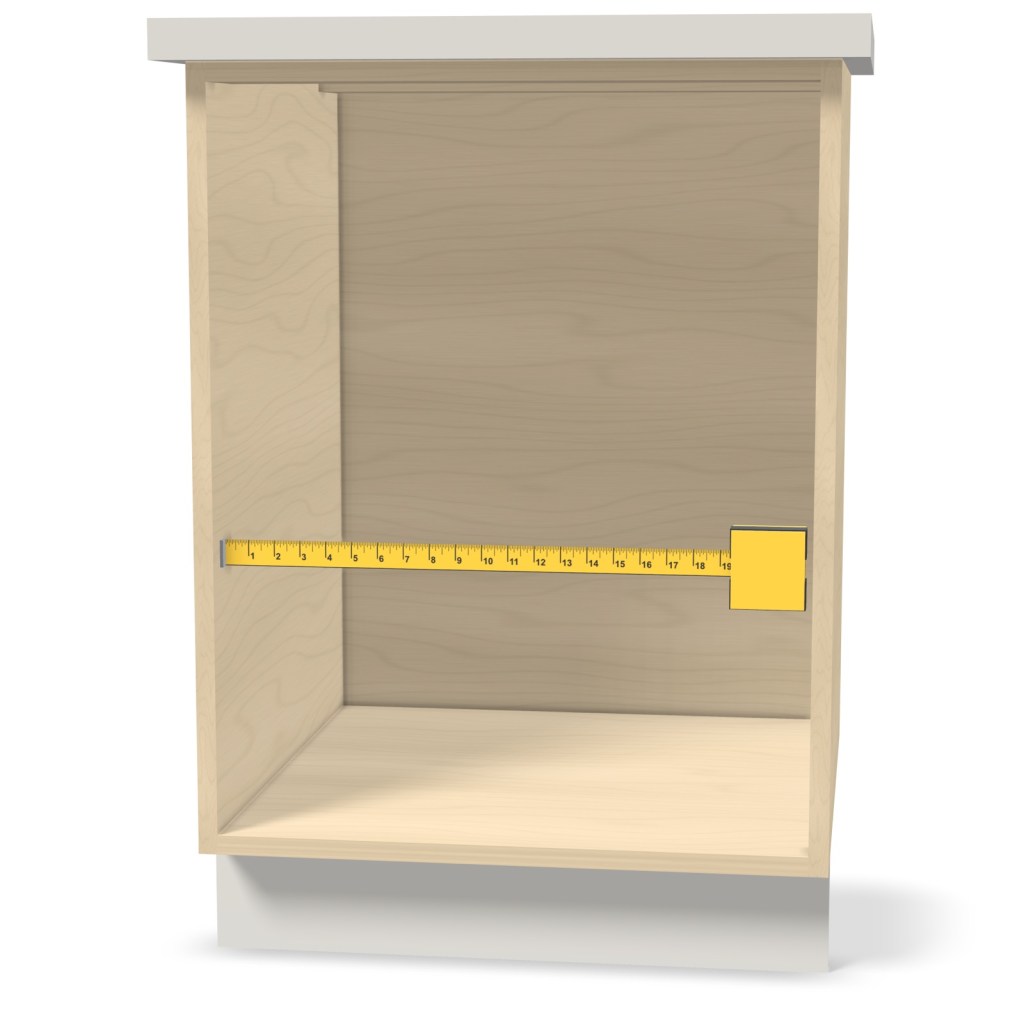
Hook the tape on the inside face of one cabinet side, or one face frame stile, and read it at the inside face of the other, at the front where the slides mount, then at the middle and the back. Write the smallest as A: a box built to the smallest number still runs, one built to the largest binds. The rule: A is the opening, not the box. On Blum style undermount runners with 5/8 in sides the box is A minus 3/8 in, the rule our standard divided drawer uses. That is 1/32 in narrower than Blum’s 42 mm inside width rule (13/32 in with 5/8 in sides), inside Blum’s +0 / −1.5 mm inside width tolerance, so the runner seats the same. On side mount slides it is A minus 1 in, 1/2 in per side. Common mistake: measuring the drawer front, which overhangs the opening, or the carcass behind a face frame, which is wider than the frame. Tip: on an old box, keep the smaller of its front and back outside widths; that is G, deduction done.
Step 2: measure the opening height (B) and the inside depth (C)

Stand the tape on the bottom of the opening, the cabinet floor or the rail below the drawer, and read it at the underside of the rail, stretcher or counter support above; write it as B. Then lay the tape along the cabinet floor from the front edge of the cabinet, or the face of the frame, to the back panel and write the inside depth as C. On an old box, measure a side bottom to top, and the box front to back without the decorative front. The rules: the box is at most B minus 3/4 in tall, the room an undermount runner needs, and our standard heights of 3 1/4, 4 1/4, 5 1/4 and 6 1/4 in are picked at or below that number. On undermount runners the box depth is the runner length and the cabinet needs a little more than the runner: Blum asks for at least 21 15/16 in of inside depth for a 21 in TANDEM runner, so C must be at least that; on side mount slides the box depth is C minus about 1 in. Common mistake: measuring the drawer front for the height; it is taller than the box behind it. Tip: take C to the first obstruction, such as a hinge plate.
Step 3: decide the box height from what goes in (D)
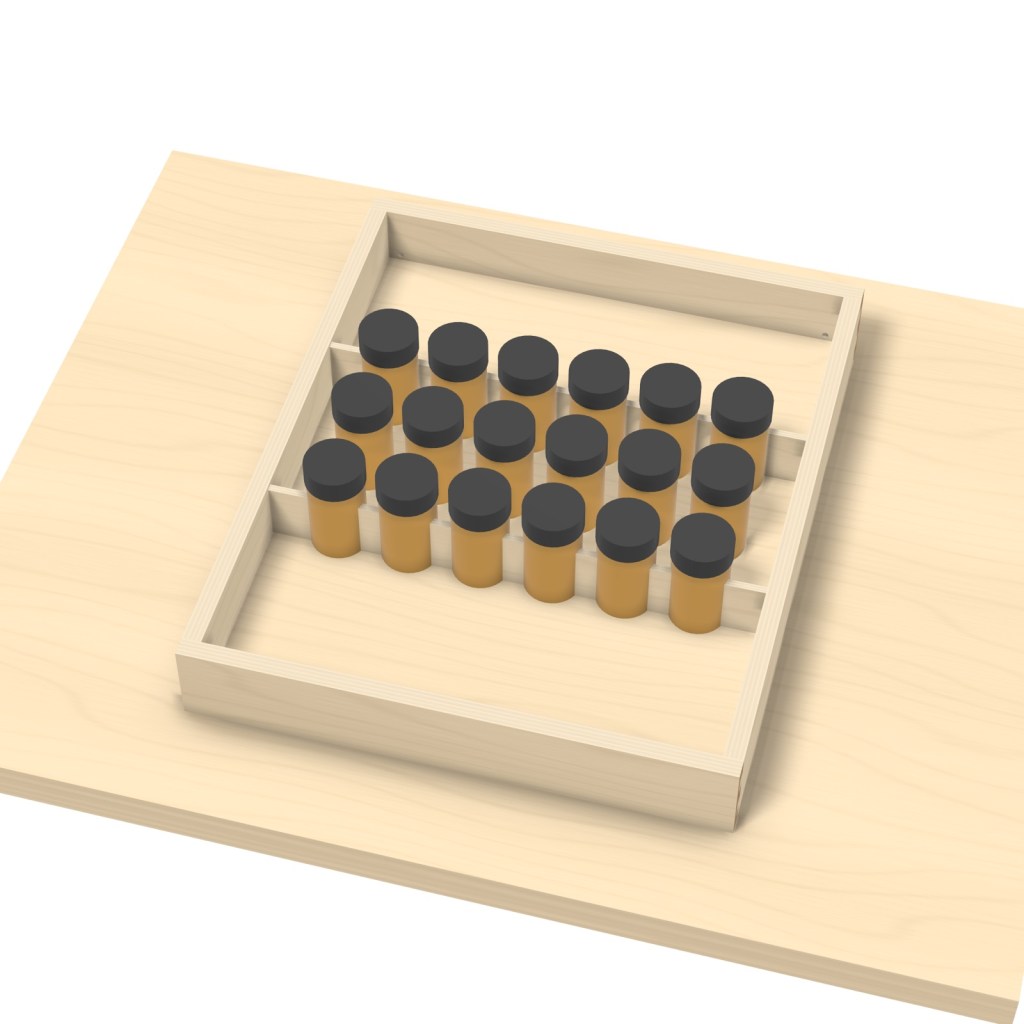
Stand the tallest thing that will live in the drawer on the counter the way it will sit, measure it, add about 1 1/2 in, and compare with B minus 3/4 in; the smaller number is the box height, D. Heights are outside heights: the bottom sits in a groove above the bottom edge and the divider tops sit 1/8 in below the top, so the inside is a little less, and the 1 1/2 in covers it.
| What goes in | Box height to order (outside) | Why |
|---|---|---|
| FLATWARE LYING FLAT | 3 to 4 in | Pieces lie about 1 in tall |
| SPICE JARS LYING FLAT | 3 1/2 to 4 in | Jars are about 1 3/4 to 2 in across |
| SPICE JARS STANDING UP | Tallest jar plus about 1 1/2 in; 6 in for 4 1/2 in jars | You grip the lid above the dividers |
| COOKING UTENSILS | 4 to 5 in | A ladle bowl on its side |
| POTS AND LIDS | 8 to 12 in | Deep drawer dividers |
The rule: the custom box runs 2 to 12 3/4 in. Common mistake: ordering a 6 in box for a 5 in opening because the jars stand up; the opening wins. Tip: for standing jars, a custom divider height about half the box height keeps the labels in view; spice drawer dividers has the jar sizes.
Step 4: measure the longest and widest items (E and F)
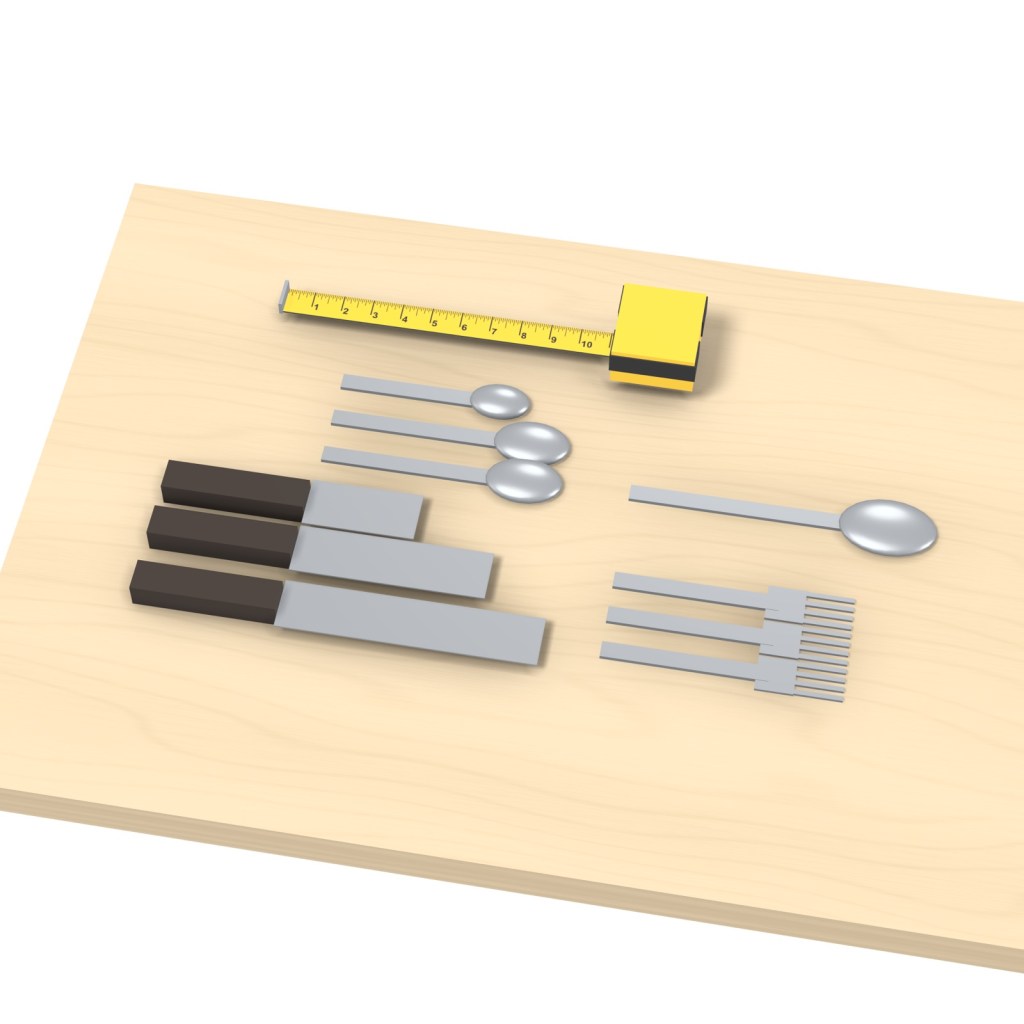
Lay everything out in groups of like things, one group per bay: forks, table knives, spoons, serving pieces. In each group, run the tape along the longest piece from tip to end of handle and write it as E, then across the widest piece, usually a spoon bowl or a spatula, and write it as F. The rule: a bay needs F plus about 1/2 in of width and E plus about 1 in of length. Typical sizes are in the Step 6 table, but patterns vary, so measure your own. Common mistake: measuring the blade and forgetting the handle. Tip: photograph the groups; kitchen drawer divider sizes lists the bay each item needs.
Step 5: work out the box width and the inside width (G, H and I)

Make the slide deduction, A minus 13/32 in (10 mm, often written 3/8 in) for Blum style undermount runners with 5/8 in sides or A minus 1 in for side mount, and write the outside box width as G; an old box’s outside width is G as measured. Write the box depth as H: the runner length for undermount, C minus about 1 in for side mount. Then take two side thicknesses off both for the inside size, where every compartment comes from: 1 1/4 in with our standard 5/8 in sides, 1 in with 1/2 in sides, 1 1/2 in with 3/4 in sides. Write the inside width and depth as I.
| Your slides | G, box width | Example, A = 22 1/2 in |
|---|---|---|
| BLUM STYLE UNDERMOUNT, 5/8 IN SIDES | A minus 13/32 in (10 mm, often written 3/8 in) | Box 22 1/8 in, inside 20 7/8 in |
| SIDE MOUNT | A minus 1 in | Box 21 1/2 in, inside 20 1/4 in |
| OTHER UNDERMOUNT RUNNER | The maker’s rule; name the model and we match the notch | Per the maker’s sheet |
The rule: every size on the custom product is the outside of the box, cut to the 1/32 inch; the standard product asks for A and deducts the 3/8 in itself. Common mistake: entering A as the custom box width. Tip: the dados take nothing from I; the undermount drawer slide guide covers runners other than Blum.
Step 6: pick the rows and bays and check each compartment (J, K and L)

Count your groups and write the bays across and the rows front to back as J; long things lie front to back in bays, boxes and jars sit side to side in rows. Convert to dividers, which is what the configurator counts: axial (front to back) is bays minus 1, lateral (side to side) is rows minus 1, 6 at most each; write them as K. Four bays in one row is 0 lateral and 3 axial. Then the check: clear bay width is the inside width minus 1/4 in per axial divider, divided by the bays; clear row depth is the inside depth minus 1/4 in per lateral divider, divided by the rows. Write it as L and compare with E and F for every group; 1/2 in dividers take 1/2 in each.
| Group, 22 1/8 x 21 in box | E, longest | F, widest | Bay needs | Four bays of 5 1/32 x 19 3/4 in |
|---|---|---|---|---|
| DINNER FORKS | 8 in | 1 in | 1 1/2 x 9 in | Fits |
| TABLE KNIVES | 9 1/2 in | 3/4 in | 1 1/4 x 10 1/2 in | Fits |
| TABLESPOONS | 8 in | 1 3/4 in | 2 1/4 x 9 in | Fits |
| SERVING PIECES | 13 in | 2 1/2 in | 3 x 14 in | Fits |
The rule: compartments equal (lateral + 1) x (axial + 1), up to 49, and the live 3D preview prints the count and size of each in its spec line. Common mistake: entering the number of bays as the number of dividers. Tip: if one group needs a wider bay, keep the counts, choose custom spacing and type the bays from the left in the layout notes; the divider layout planner works a mixed layout bay by bay.
Step 7: match a standard size, or build the custom box

Look at A. If it is one of the eight openings below, the slides are 21 in undermount runners, C is at least 21 15/16 in and one of the seven set layouts matches J, order the standard divided drawer box: three picks, with the deduction and the 21 in depth already made. Anything else, a fraction over or under, a face frame opening, side mount slides, another depth, removable or movable dividers, 1/2 in dividers or custom spacing, is the custom divided drawer box, built to G, H and D exactly, at the same price for the same build.
| Your A | Box, G | Four bays each |
|---|---|---|
| 13 1/2 in (15 in cabinet) | 13 1/8 in | 2 25/32 in |
| 16 1/2 in (18 in cabinet) | 16 1/8 in | 3 17/32 in |
| 19 1/2 in (21 in cabinet) | 19 1/8 in | 4 9/32 in |
| 22 1/2 in (24 in cabinet) | 22 1/8 in | 5 1/32 in |
| 25 1/2 in (27 in cabinet) | 25 1/8 in | 5 25/32 in |
| 28 1/2 in (30 in cabinet) | 28 1/8 in | 6 17/32 in |
| 31 1/2 in (33 in cabinet) | 31 1/8 in | 7 9/32 in |
| 34 1/2 in (36 in cabinet) | 34 1/8 in | 8 1/32 in |
The rule: do not round A to a standard size; undermount runners need the box to match the opening, so a 22 3/4 in opening gets a custom 22 3/8 in box. Common mistake: going by the cabinet’s nominal width instead of A. Tip: standard size divided drawers lists all seven layouts with the bay width each leaves.
Every measurement on one drawing
The letters match the worksheet below.
Your worksheet
Copy these twelve lines, one sheet per drawer: A to F are measured, G to L are worked out. Screenshot the filled table, or send a photo of it with the instant quote.
| Line | What it is | Your number | Rule or minimum |
|---|---|---|---|
| A. OPENING WIDTH | Inside face to inside face, smallest of three | ______ in | Or the old box’s outside width |
| B. OPENING HEIGHT | Floor or rail below to the rail above | ______ in | Box at most B minus 3/4 in tall |
| C. INSIDE DEPTH | Front edge to the back panel or first obstruction | ______ in | Runner length plus 3/4 in |
| D. BOX HEIGHT | Tallest item plus about 1 1/2 in, at most B minus 3/4 in | ______ in | 2 to 12 3/4 in; standard 3 1/4 to 6 1/4 in |
| E. LONGEST ITEM, PER GROUP | Tip to end of handle | ______ | Row depth beats E plus 1 in |
| F. WIDEST ITEM, PER GROUP | Across the widest piece | ______ | Bay width beats F plus 1/2 in |
| G. BOX WIDTH | A minus 13/32 in (10 mm, often written 3/8 in) (undermount) or 1 in (side mount) | ______ in | 6 to 35 31/32 in, never wider than A |
| H. BOX DEPTH | Runner length, or C minus about 1 in for side mount | ______ in | 21 in on the standard product |
| I. INSIDE WIDTH AND DEPTH | G and H minus 1 1/4 in with 5/8 in sides | ______ x ______ in | Minus 1 in with 1/2 in sides, 1 1/2 in with 3/4 in sides |
| J. BAYS AND ROWS | One bay per group; rows front to back | ______ x ______ | Up to 7 each way |
| K. DIVIDER COUNTS | Lateral = rows minus 1; axial = bays minus 1 | Lateral ____ Axial ____ | 0 to 6 each, at least 1 in total |
| L. COMPARTMENT SIZE | (I width minus axial x 1/4) / bays, by (I depth minus lateral x 1/4) / rows | ______ x ______ in | Beats F plus 1/2 in by E plus 1 in |
Have your numbers? Build your divided drawer: enter G, H, D and the two counts, and the live 3D drawing shows every divider at your exact size with the compartment size in the spec line, while a red warning stops any box we cannot build. If A is a standard opening, pick the standard divided drawer in three fields instead.
Turn your numbers into an order
A real top drawer: a 24 in frameless base cabinet on Blum TANDEM 563H 21 in runners from our undermount slides shop, holding the flatware from Step 6. A = 22 1/2, B = 5 and C = 23 in, so D is 4 1/4 in (5 minus 3/4), G is 22 1/8 in, H is 21 in, I is 20 7/8 x 19 3/4 in, J is 4 bays in 1 row, K is 0 lateral and 3 axial, and L is 5 1/32 x 19 3/4 in, which beats every group. A is a standard opening, so the standard product takes it in three picks, quoted as the configurator prints them.
| Line | Standard divided drawer box field | Choose |
|---|---|---|
| A | “Cabinet opening” | “22 1/2″ opening (24″ cabinet), box 22 1/8″ wide” |
| D | “Box height” | “4 1/4″ tall” |
| J, K | “Divider layout” | “Four bays, front to back, for flatware (3 dividers)” |
| Slides | “Slides” and “Locking clips” | “Blum TANDEM, 21″ (our standard)” and “Install the matching Blum locking clips”, or “No clips” to reuse yours |
Any other drawer, or this one on the custom product, maps like this. On side mount slides leave “Notching” on “None” and the depth comes from “Custom Depth (Inches)” and “Depth Fraction” instead of “Depth Selection”.
| Line | Custom divided drawer box field | Choose, for the 24 in flatware drawer |
|---|---|---|
| G | “Width (Inches)” and “Width Fraction” | “22” Dovetail Drawer Box” and 1/8″ |
| D | “Height (Inches)” and “Height Fraction” | “4” Inches (H)” and 1/4″ |
| H | “Notching”, “Slide Brand/Model”, “Depth Selection” | “Notched & Drilled For Undermount Slides”, “Blum TANDEM plus BLUMOTION 563”, “21” Inches (D)” |
| K | “Lateral dividers (side to side)” and “Axial dividers (front to back)” | “0 lateral dividers” and “3 axial dividers” |
| Style | “Divider style”, “Divider thickness”, “Divider height” | “Fixed in dados”, “1/4″ thick dividers (our standard)”, “Standard (1/8″ below box top)” |
| L | “Divider spacing” | “Equal spacing”, or “Custom spacing (describe it below)” with the bays from the left in “Layout notes” |
| Clips | “Clips” | “Blum T51.1901 Clips” from our clips and brackets shop, or “No Clips” |
Keep “Drawer Side Thickness” on “5/8″ Thick Drawer Sides (Our Standard)”, which the 1 1/4 in deduction assumes. On side mount slides G becomes 21 7/16 in, H is 22 in from “Custom Depth (Inches)”, and the four bays come out about 4 7/8 in wide. The divided drawer configurator guide walks every field and price.
Check your numbers
A box built to your measurements is not returnable and there is no fit guarantee, so run the sheet through these before you add it to your cart.
- Width. G is A minus 13/32 in (10 mm, often written 3/8 in) on Blum style undermount runners with 5/8 in sides, A minus 1 in on side mount slides, never wider than A.
- Height. D is at most B minus 3/4 in and at least the tallest item plus about 1 1/2 in; the opening wins.
- Depth. Undermount: H is the runner length and C is at least that plus 3/4 in. Side mount: H is about 1 in less than C.
- Counts. 0 to 6 each way with at least one of them 1 or more; at 0 and 0 the preview shows a red warning and holds Add to cart, as it does for a custom divider height under 1/2 in or less than 1/8 in below D.
- Compartments. Every bay beats F plus 1/2 in and every row beats E plus 1 in. The spec line prints the compartment size, but comparing it with your items is your job. With custom spacing, the bays plus the dividers must add up to the inside width; we contact you if they do not.
- Standard size. A is one of the eight openings to the mark, C is at least 21 15/16 in and the runners are 21 in undermount; otherwise it is the custom box.
Measuring questions
Do I give you the cabinet opening or the box size for a divided drawer?
It depends on the product. The standard divided drawer box asks for the cabinet opening and makes the 3/8 in undermount deduction for you. The custom divided drawer box asks for the outside box size, so you deduct 13/32 in (10 mm, often written 3/8 in) for Blum style undermount runners with 5/8 in sides or 1 in for side mount slides, and we build exactly that.
What is the slide deduction for a divided drawer?
The same as for any drawer box, because the dividers sit inside it. Side mount slides need a box 1 in narrower than the opening; Blum style undermount runners with 5/8 in sides need 13/32 in (10 mm, often written 3/8 in). For another runner, follow the maker’s sheet and name the model in the configurator so we match the notch.
How tall should a divided drawer box be?
At most the opening height minus 3/4 in, and at least the tallest item plus about 1 1/2 in. That puts flatware in a 3 to 4 in box, utensils in 4 to 5 in, spice jars lying flat in 3 1/2 to 4 in and standing jars in about 6 in.
How do I measure a face frame cabinet for a divided drawer?
Measure inside the frame, stile to stile and rail to rail, not the wider carcass behind it. The box takes the same deduction from that frame opening, and the slides mount on blocking flush with the frame. Frame openings rarely land on the eight standard sizes, so a face frame cabinet usually takes the custom box.
How exact do my measurements need to be?
To the nearest 1/32 in on the opening, because we cut to the 1/32 inch and the fraction fields take 1/32 in steps. A width 1/8 in too big binds; 1/8 in too small still runs, so between marks, round the opening down. Round item sizes up to the nearest 1/4 in.
Can I send a photo of my measurements instead of using the configurator?
Yes. Fill in the worksheet, photograph it with the tape in the opening, and send both through the instant quote; we check the numbers and tell you which product and picks to order. A layout the configurator cannot draw, such as clip grooves, goes the same way.
Related reading
- How to measure for a drawer box: the plain box version.
- Divider layout planner: the bay by bay worksheet and a printable grid.
- Kitchen drawer divider sizes: the bay each kitchen item needs.
- Drawer divider layouts: lateral vs axial and the compartment tables.
- Standard size divided drawers: eight widths, four heights, seven layouts.
- Spice drawer dividers and knife drawer with built in dividers: the two common special cases.
Twelve lines and the drawer is on its way
Enter G, H, D and your two divider counts, read the compartment size off the spec line, and we build the dividers into a dovetailed box in our Las Vegas shop, built to order, shipped assembled with free retail shipping and covered by the lifetime warranty on the wood box. Not sure about a number? Send us a photo and your measurements and we check them first.